
How Smoking and Vaping Can Affect Dental Implant Healing

Dental implants need time to become stable inside the jawbone. During this healing period, the gum tissue must recover, blood supply must support the surgical area, and the bone must gradually integrate with the implant surface. Smoking and vaping can interfere with several of these processes, which is why tobacco and nicotine use are important factors to discuss before implant treatment.
Understanding How Smoking and Vaping Can Affect Dental Implant Healing is especially important for patients who assume that vaping is harmless or that smoking only becomes a problem after the implant has already healed. In reality, the early weeks after implant placement are a particularly sensitive period, but smoking may also influence the long-term health of the tissues around an implant.
This does not mean that every smoker is automatically unable to receive an implant. It means that smoking status, nicotine use, gum condition, bone quality, oral hygiene and the complexity of the planned treatment should all be considered before surgery. A personalized assessment is especially important for patients considering dental implants in Georgia, where the treatment plan should account for both surgery and the healing period that follows.
How Smoking and Vaping Can Affect Dental Implant Healing During the First Weeks
The first stage of implant healing is not simply about waiting for the surgical site to close. The body is rebuilding soft tissue and bone around a newly placed implant. Good blood flow, adequate oxygen delivery and a controlled inflammatory response are all important during this process.
Smoking can interfere with these conditions. Nicotine causes blood vessels to constrict, while cigarette smoke contains substances that can reduce oxygen delivery and affect normal tissue repair. This can make the healing environment less favorable around the implant.
Vaping avoids some products of tobacco combustion, but that does not make it risk-free. Many e-cigarettes contain nicotine, and research has also raised concerns about inflammatory changes associated with vaping. Current evidence on vaping and dental implants is less extensive than the evidence on cigarette smoking, so it is more accurate to say that vaping should be treated as a potential risk factor rather than a proven safe alternative during implant healing.
Smoking Can Reduce the Quality of Early Soft-Tissue Healing
After implant placement, the gum tissue surrounding the surgical area needs to heal properly. Healthy soft tissue helps protect the implant site from bacteria and supports long-term stability around the restoration.
Smoking can reduce blood flow in oral tissues and may impair the body's normal healing response. This is one reason smokers may have a greater risk of postoperative complications compared with non-smokers.
An important detail is that smokers may sometimes show less visible gum bleeding because nicotine constricts blood vessels. Less bleeding does not necessarily mean healthier tissue. It can actually make inflammation less obvious during routine observation.
Here you can read more about What to eat after dental implant surgery? A First-Week Food Guide
Smoking May Interfere With Osseointegration
Osseointegration is the biological process in which bone forms a stable connection with the implant surface. This process usually takes several weeks to months and is essential before the implant can safely support its final restoration.
Research consistently associates smoking with poorer implant outcomes and a higher risk of early implant failure. Smoking can affect bone metabolism, blood supply and tissue oxygenation, all of which are relevant to osseointegration.
This is particularly important for larger treatments such as full mouth dental implants, because several implants may be supporting a complete prosthesis. Protecting the healing phase becomes part of protecting the entire rehabilitation.
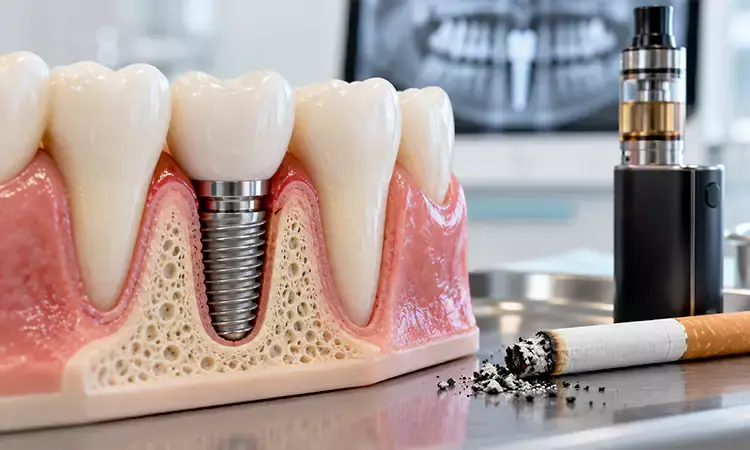
Smoking vs Vaping: Which Is Worse for Dental Implant Healing?
Cigarette smoking has been studied for much longer than vaping, so the evidence is much stronger. Multiple systematic reviews have linked cigarette smoking with higher implant failure rates, increased marginal bone loss and a greater risk of biological complications around implants.
Vaping is newer, which means there are fewer long-term clinical studies involving dental implant patients. However, available research does not support the idea that vaping is harmless to peri-implant tissues. Nicotine exposure remains a concern, and some studies have identified inflammatory changes and poorer peri-implant clinical findings among e-cigarette users compared with non-users.
The practical conclusion is not that cigarettes and e-cigarettes carry exactly the same level of risk. Rather, patients should avoid assuming that switching from smoking to vaping immediately before implant surgery removes the healing concern.
Habit | Main Concern During Implant Healing | Current Evidence |
Cigarette smoking | Reduced blood supply, delayed healing, impaired osseointegration, increased implant failure risk | Strong evidence of poorer implant outcomes |
Nicotine-containing vaping | Nicotine-related vasoconstriction and possible inflammatory effects | Growing evidence, but fewer long-term implant studies |
Nicotine-free vaping | Exposure to heated aerosols and other substances may still affect oral tissues | Evidence is limited; it should not automatically be considered harmless |
No smoking or vaping | Removes tobacco and vaping-related healing risks | Provides a more favorable healing environment |
Cigarettes Add More Than Nicotine
Nicotine is only one part of the problem with conventional smoking. Cigarette smoke contains carbon monoxide and numerous other compounds that can affect circulation, immune response and tissue repair.
For this reason, simply focusing on the number of cigarettes smoked per day can underestimate the broader effect of smoking on oral healing. Higher smoking exposure has been associated with greater implant risk, but even lighter smoking should be disclosed to the implant dentist.
Vaping Is Not a Proven Safe Substitute During Recovery
Patients sometimes plan to stop cigarettes after implant surgery but continue vaping instead. From a healing perspective, this should not be done without discussing it with the treating clinician.
If the vape contains nicotine, the vasoconstrictive effect of nicotine remains relevant. Even nicotine-free products expose oral tissues to heated aerosols and chemical compounds whose long-term effects around implants are not yet fully understood.
Because dental implants are intended to last for many years, it makes more sense to reduce avoidable risk than to assume that the absence of tobacco smoke makes vaping safe.
Can Smokers Still Have Dental Implants?
Yes. Smoking is generally considered a risk factor rather than an automatic contraindication to dental implant treatment. Many smokers receive implants successfully, but the probability of complications is higher than in non-smokers, so careful planning and honest disclosure are important.
Before approving treatment, the dentist or implant surgeon may consider smoking frequency, gum health, bone quantity and quality, medical conditions, oral hygiene and whether additional procedures such as bone grafting are required.
For patients considering full-arch treatment such as All-on-4 dental implants, smoking becomes particularly important because the procedure involves multiple implants supporting a fixed restoration. The healing plan should therefore be discussed before travel and surgery, not after a complication develops.
The Amount You Smoke May Matter
Studies suggest a dose-response relationship, meaning heavier cigarette consumption may be associated with greater implant risk. However, there is no universally safe number of cigarettes during implant healing.
A patient who smokes only occasionally should still tell the dental team. Smoking history is part of treatment planning in the same way that diabetes, periodontal disease, medications and previous dental surgery may influence the plan.
The most useful approach is not to hide or minimize smoking, but to allow the clinician to assess the risk accurately and give realistic instructions.
Gum Disease and Smoking Can Create Additional Risk
Smoking is already associated with periodontal disease, and the condition of the gums and supporting bone is important before implant placement.
If active gum disease is present, it may need to be controlled before surgery. After implant placement, long-term plaque control and professional follow-up remain important because inflammation around an implant can progress to peri-implant disease and bone loss.
Patients who smoke therefore need to be especially consistent with oral hygiene and scheduled follow-up.
How Long Should You Stop Smoking Before and After Dental Implant Surgery?
There is no single cessation period that is appropriate for every patient and every implant procedure. Recommendations vary according to the type of surgery, the patient's smoking history, the number of implants being placed and whether bone grafting or other procedures are involved.
The key principle is that stopping only for the day of surgery does not provide the same benefit as avoiding smoking throughout the important healing phase. Your implant surgeon should provide individualized instructions.
At alo.dr, patients are advised to avoid smoking during implant recovery, with particular emphasis on the first several weeks after surgery. The dental implant treatment page currently recommends avoiding smoking especially during the first four to six weeks of healing.
Before Implant Surgery
Tell your dentist how often you smoke or vape and what products you use. This includes cigarettes, e-cigarettes, heated tobacco and other nicotine products.
If you are able to stop before surgery, discuss a realistic cessation plan with your healthcare provider. Patients who have difficulty quitting should not simply conceal their smoking. The dental team needs accurate information to plan treatment and aftercare safely.
If nicotine-replacement products are being considered, ask your doctor or implant surgeon how they fit into your individual medical and surgical plan rather than making changes independently.
After Implant Surgery
The days and weeks after implant placement are particularly important because the surgical wound is healing and osseointegration is beginning.
Avoiding smoking and vaping during this period removes a preventable source of irritation and nicotine exposure. Patients should also follow their prescribed oral-hygiene instructions, avoid disturbing the surgical area, follow dietary recommendations and attend scheduled follow-up appointments.
If you accidentally smoke after surgery, do not assume the implant will automatically fail. Inform your dental team, stop again if possible and continue following the rest of your recovery instructions.
Signs That Dental Implant Healing Should Be Checked
Some discomfort, mild swelling and tenderness can be expected after implant surgery. These symptoms usually improve as healing progresses.
However, patients should contact their dental team if symptoms are worsening rather than improving, particularly if there is increasing swelling, persistent or significant bleeding, discharge, fever, severe pain or a sensation that the implant or temporary restoration is moving.
Smokers and vapers should be particularly careful not to use reduced bleeding as proof that the tissue is healthy. Nicotine-related vasoconstriction can reduce visible bleeding even when inflammation is present.
Regular follow-up therefore matters even when the implant appears comfortable.
How to Improve Your Chances of Successful Dental Implant Healing
Understanding How Smoking and Vaping Can Affect Dental Implant Healing is useful only if it leads to better decisions during recovery. Smoking cessation is one important step, but successful healing also depends on the overall treatment plan and aftercare.
Follow the cleaning instructions provided by your dentist rather than aggressively brushing the surgical site. Take prescribed medications exactly as directed. Choose appropriate foods during the early recovery period and avoid unnecessary pressure on newly placed implants.
If you are having implant treatment abroad, make sure you also understand how follow-up will be handled once you return home. For extensive rehabilitation such as full mouth dental implants, the months between implant placement and final prosthetic treatment are an active healing period, not simply a waiting period.
Most importantly, be honest about smoking or vaping from the beginning. The purpose is not to judge the habit. It is to give the dental team the information needed to reduce avoidable risk and protect the investment you are making in your treatment.
Final Thoughts on How Smoking and Vaping Can Affect Dental Implant Healing
The evidence is clearest for cigarette smoking: smokers have a higher risk of implant complications and failure than non-smokers, and smoking can negatively affect soft-tissue healing, bone integration and long-term peri-implant health.
The evidence on vaping is newer and less complete, but current research does not justify treating e-cigarettes as harmless during dental implant recovery. Nicotine-containing vaping remains particularly relevant because nicotine affects blood vessels and tissue healing.
If you smoke or vape and are considering dental implants, the best next step is not to assume that you are unsuitable for treatment. Instead, discuss your smoking or vaping history during your consultation so that your implant surgeon can evaluate your individual risk, plan the procedure appropriately and give you clear instructions for the healing period.
Frequently Asked Questions
Can I get dental implants if I smoke? Yes. Smoking does not automatically prevent implant treatment, but it is associated with a higher risk of implant failure and peri-implant complications. Your dentist should evaluate your smoking history, gum health, bone condition and overall health before treatment.
Is vaping safer than smoking after dental implant surgery? There is currently less long-term evidence about vaping than cigarette smoking, but vaping should not be considered risk-free. Nicotine-containing e-cigarettes may affect blood flow and healing, while the effects of other aerosol components on peri-implant tissues are still being studied.
What happens if I smoke once after implant surgery? Smoking once does not mean that the implant will definitely fail, but it adds an avoidable risk during a sensitive healing period. Stop again if possible, continue your prescribed aftercare and contact your dental team if you develop increasing pain, swelling, discharge, bleeding or implant mobility.


Comments